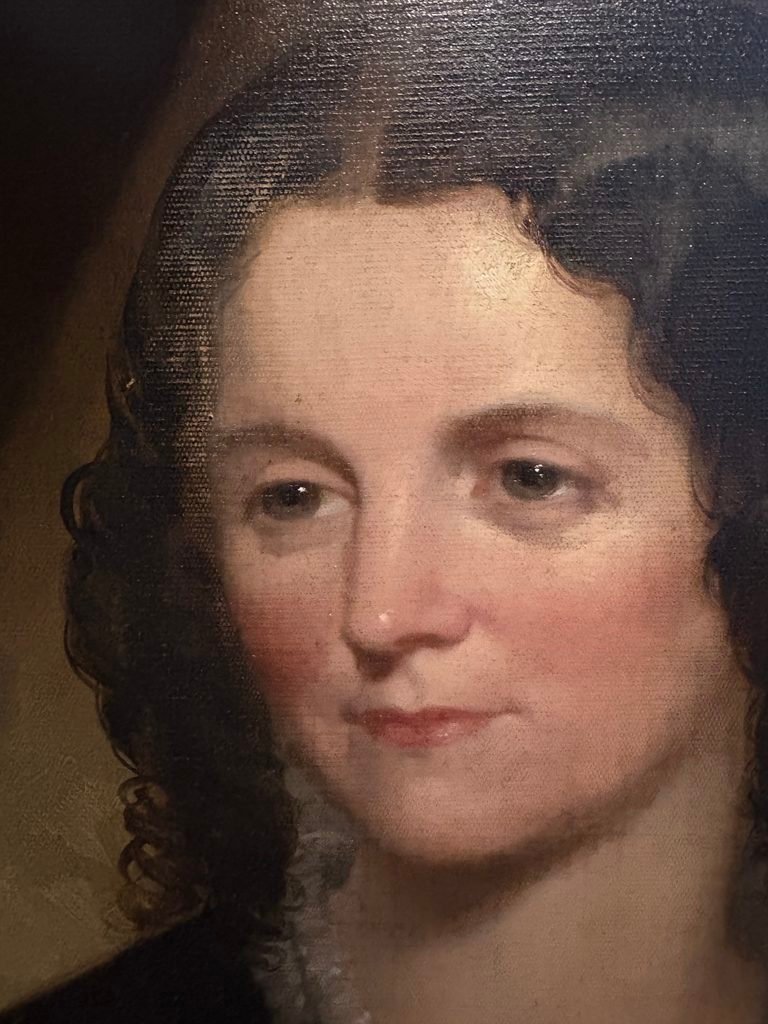
Unsigned, Portrait of a Woman, approximately 1850-60s. Provenance; Mendocino county, CA
Seeing the Unseen: What a Forgotten Portrait Taught Me About Beauty, Grief, and Hope
Zlatoslava Karga, PMH NP, DNP
As a psychiatric nurse practitioner, I spend much of my professional life helping people explore what lies beneath the surface. Symptoms tell a story, but rarely the whole story. Human beings are infinitely more complex than the first impression they make.
Perhaps that is one reason I have become such an avid art collector.
Among my favorite pieces to collect are Victorian family portraits. There is something profoundly moving about preserving the faces of people who would otherwise be forgotten by history. Their names may be lost. Their stories may be gone. Yet their humanity remains.
Recently, while browsing a local thrift store, I came across an extraordinary portrait of a woman. The painting was unremarkable to some observers. In fact, when I brought it home, several members of my family immediately responded with the same judgment:
“What an ugly woman.”
I disagreed.
The longer I sat with the portrait, the more beautiful she became.
Not because she fit a modern standard of beauty. Not because she had perfect features. Rather, because her face revealed something deeper. Her eyes held a story.
When I look at this woman, I am looking into the face of someone who has been dead for many years. I do not know her name. I do not know who painted her. I do not know where she lived, whom she loved, or what hardships she endured.
And yet, somehow, I feel I know something about her.
I see hope.
I see love.
I see resilience.
I see someone who survived grief.
There is a quiet sadness in her expression, but it is not despair. It is the sadness of a person who has suffered loss and continued forward. Her eyes suggest someone who buried loved ones, endured disappointments, and experienced the inevitable sorrows of life. Yet they also reveal tenderness and expectation. There is still a future in those eyes. There is still warmth.
That is the remarkable power of art.
A great work of art does not simply show us what a person looked like. It reveals something about who they were.
This is why I believe it is important to visit museums and galleries. It is important to sit in front of a single work of art and allow yourself to truly absorb it. Not to rush from painting to painting, taking photographs along the way, but to slow down and listen.
Every meaningful artwork contains layers of communication. Some messages are obvious. Others are hidden. They emerge only when we spend time with the piece and allow it to speak.
In our modern world, we are surrounded by images. Thousands of photographs pass before our eyes each week. Many of them are selfies, carefully curated snapshots intended to present a particular version of ourselves. They may communicate something genuine, but often they remain on the surface.
I am not speaking about the art of photography itself. Photography can be profound and deeply moving. Rather, I am reflecting on our culture’s tendency to consume images quickly, without contemplation.
Art asks something different of us.
Art asks us to pause.
To observe.
To wonder.
To see beyond appearances.
The portrait in my thrift store find reminds me that beauty is not always found in symmetry, youth, or perfection. Sometimes beauty resides in endurance. Sometimes it lives in the quiet dignity of a face that has known suffering and still chooses hope.
As a mental health provider, I am reminded daily that every person carries an unseen story. We often judge ourselves and others based on what is immediately visible. Yet beneath every face is a lifetime of victories, heartbreaks, sacrifices, and dreams.
Perhaps that is why this unknown woman’s portrait speaks to me so strongly.
She is gone. Her name may never be known again.
But her eyes continue to tell a story.
More than a century later, they still speak of love, loss, courage, and hope.
And if we are willing to look closely enough, they remind us that the most important things about a person are often the things that cannot be seen at first glance.