Reflections on German porcelain, the ashes of history, and the quiet persistence of beauty
By Zlatoslava Karga
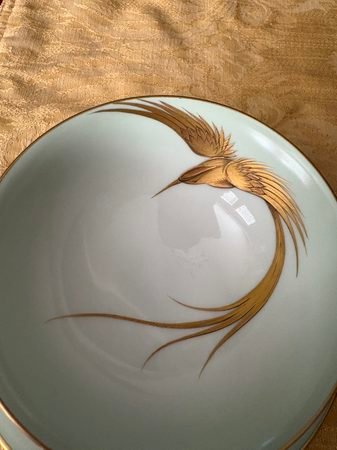
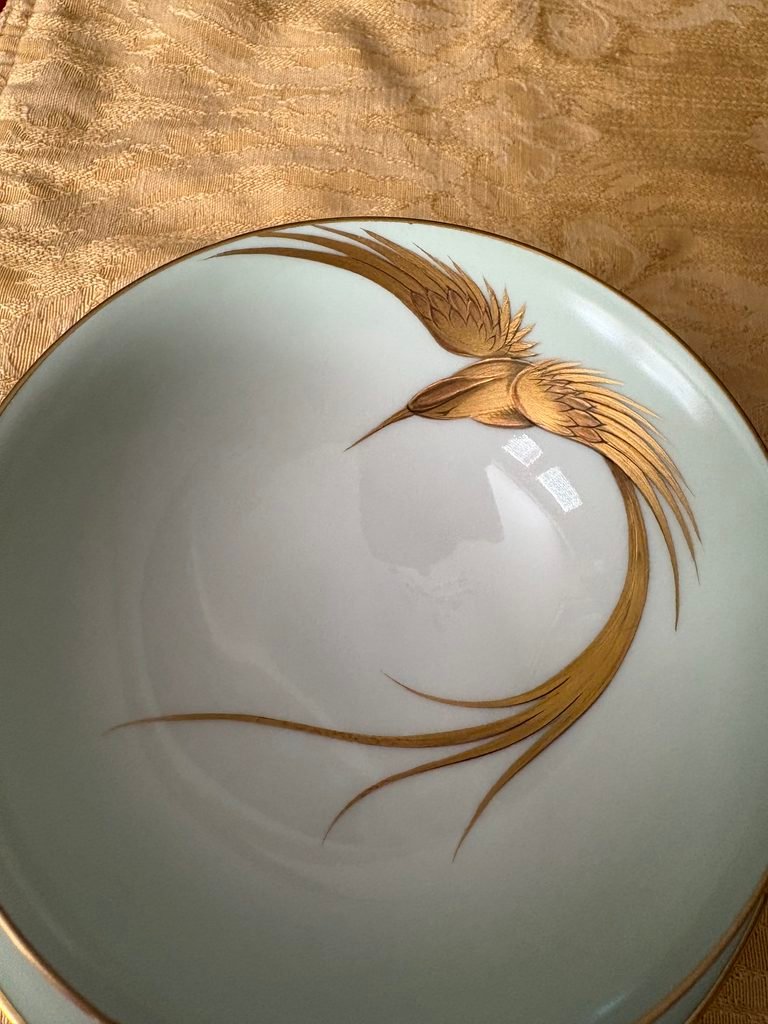
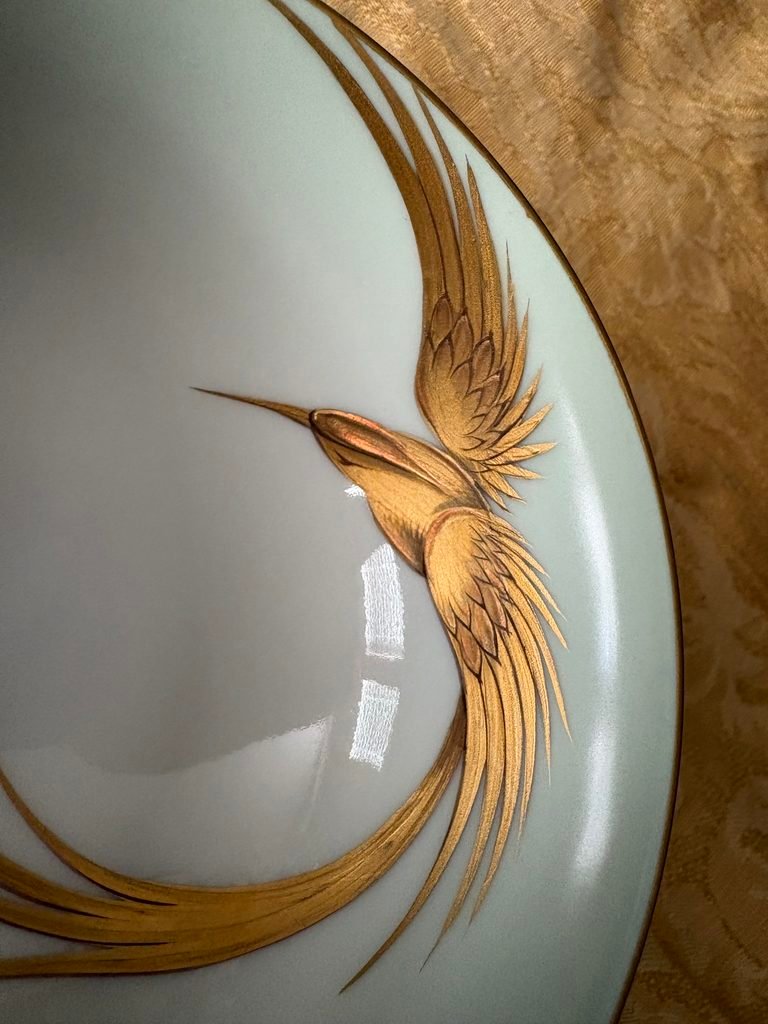
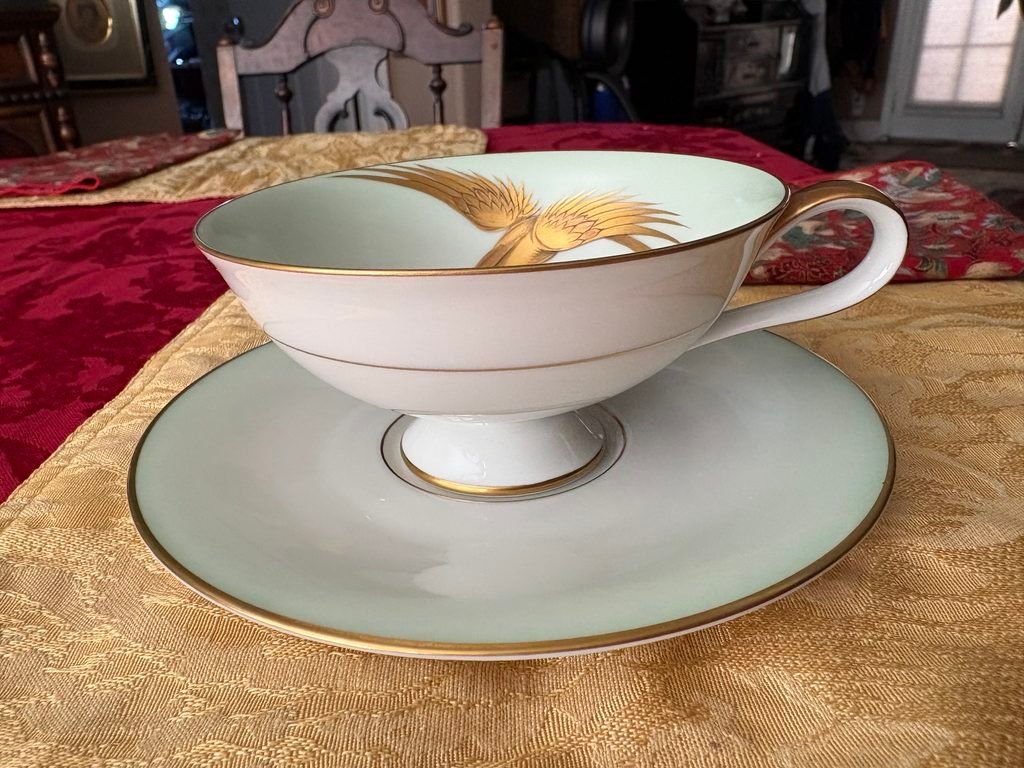
Recently, I came across an extraordinary porcelain tea set. At first glance, its design appeared remarkably simple: a delicate, pale green interior, an elegant white exterior, restrained gold trim, and a magnificent golden bird sweeping across the surface of the cup.
But the longer I studied this little work of art, the more captivated I became.
The bird, which I interpret as a phoenix, is rendered with astonishing grace. Its wings stretch outward, while its long, flowing tail follows the curvature of the cup. The artist used remarkably few elements to create an impression of movement, freedom, and almost weightless flight.
There is no elaborate background, no crowded ornamentation, no unnecessary decoration. Just a golden bird, suspended in flight against a quiet, almost ethereal background.
And perhaps that simplicity is precisely what makes the design so powerful.
The Story Behind the Porcelain Mark
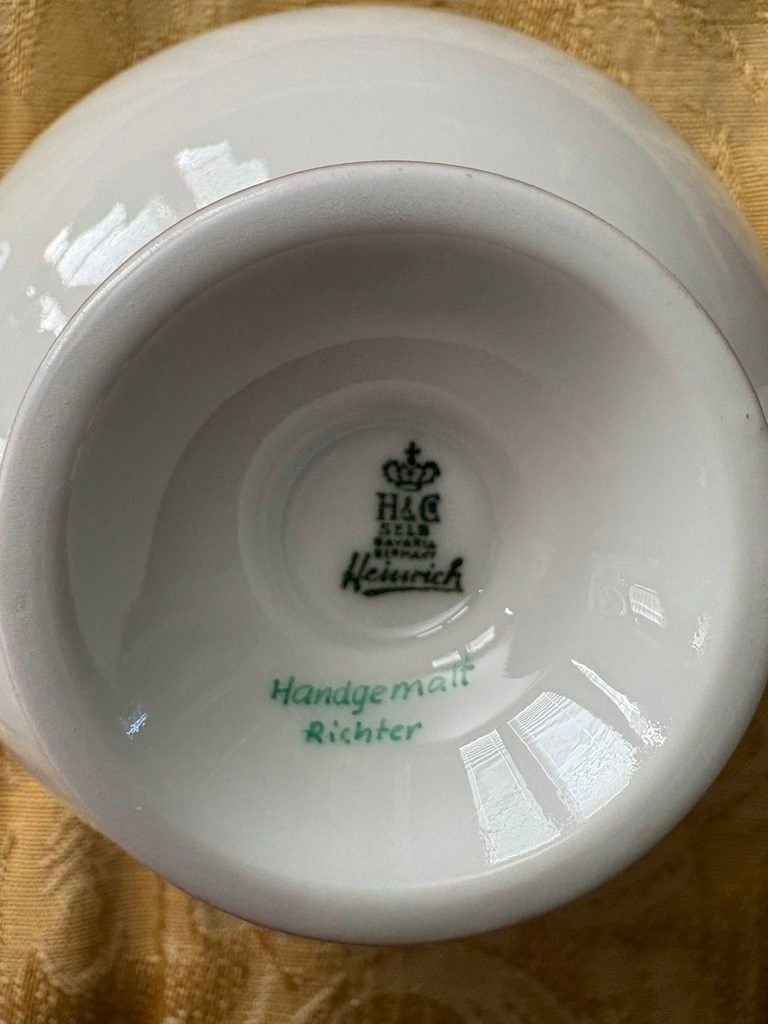
When I turned the cup over, I discovered several intriguing markings.
The principal manufacturer’s mark reads H & Co., Selb, Bavaria, Germany, Heinrich, identifying the porcelain with the distinguished German manufacturer Heinrich & Co.
The additional inscription Handgemalt Richter indicates hand-painted decoration associated with the name Richter.
Another marking refers to Seethal, Chiemsee, a location in Bavaria associated with Heinrich’s decorative art operations.
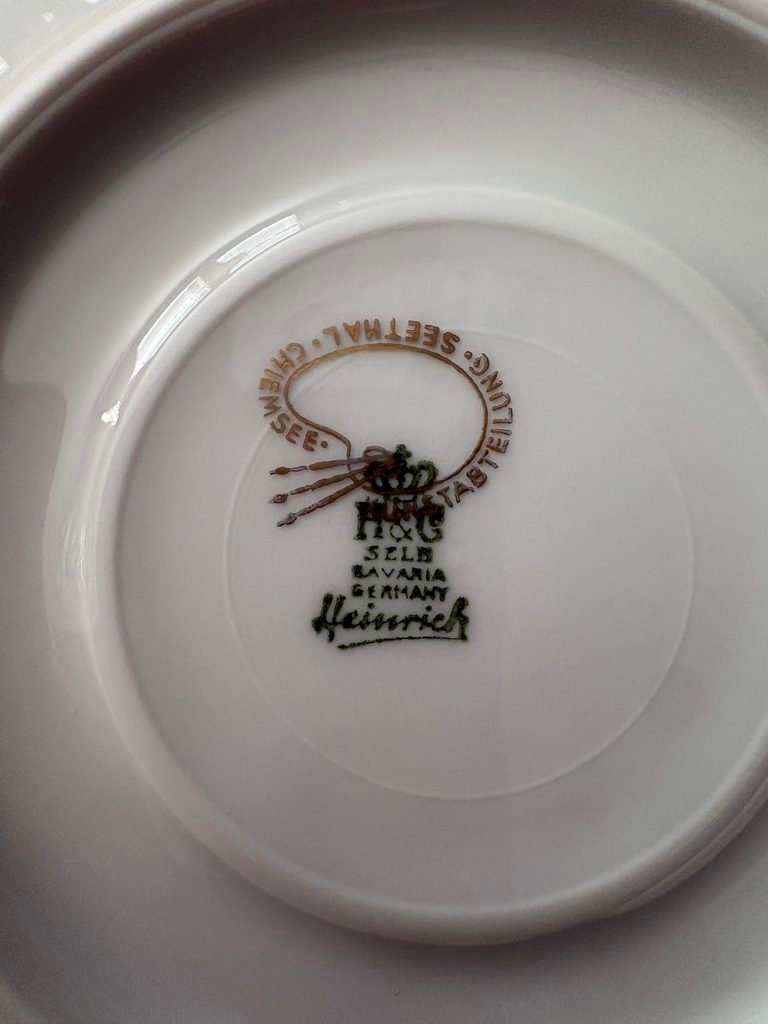
These markings tell us something important: the porcelain itself and its artistic decoration may represent different stages of production.
Heinrich & Co. traces its beginnings to 1896, when Franz Heinrich established a porcelain painting business in Selb, Bavaria. By 1901, the enterprise had begun manufacturing its own porcelain and eventually developed into one of Germany’s significant porcelain producers.
What I find particularly fascinating is that Heinrich resumed production shortly after the Second World War.
The company survived one of the most devastating periods in European history and continued its tradition of porcelain craftsmanship.
The markings and decorative style suggest that this particular set may date from the middle decades of the twentieth century, possibly the 1950s through the 1970s. A precise date and the identity of the decorator Richter remain to be established.
Nevertheless, the historical period itself gives this little cup an extraordinary context.
A Phoenix Above the Ashes
Let us travel back to Germany in the middle of the twentieth century.
The Second World War had ended in 1945, leaving much of Germany devastated. Cities lay in ruins. Millions of people had been killed, displaced, or separated from their families. The country was occupied, divided, and burdened by the enormous moral and historical consequences of the Nazi regime.
Germany faced not only the physical task of rebuilding its cities and economy, but also the far more complicated challenge of confronting its past.
In the immediate postwar years, everyday survival often took precedence over beauty. Food, shelter, employment, and the search for missing relatives were urgent concerns.
One can hardly imagine that an exquisitely decorated porcelain cup would have been a priority for someone struggling to rebuild a life among the ruins.
And yet, porcelain factories returned to production. Artists returned to their brushes. Craftsmen once again devoted their attention to the delicate details of objects that served purposes far beyond simple necessity.
By the 1950s and 1960s, West Germany was experiencing its remarkable economic recovery, often called the Wirtschaftswunder, or economic miracle.
Bavaria, too, was changing. Industry was recovering, prosperity was gradually returning, and German manufacturers were once again producing objects intended not merely for survival, but for the enjoyment of life.
It was within this broader atmosphere of reconstruction and renewal that porcelain such as this found its place.
And here is where my interpretation becomes personal.
I cannot know what the artist intended when painting this golden bird. Perhaps it was simply an elegant decorative motif, chosen for its graceful shape and luxurious appearance.
But to my eyes, it is a phoenix.
A bird that rises from its own ashes.
A creature whose destruction does not signify the end, but the possibility of a new beginning.
I find something deeply moving in the thought of a German porcelain artist, working in a country still confronting the consequences of war, creating an image that seems to speak of resilience.
As though the bird were quietly saying:
What has been destroyed cannot always be restored. What has been done cannot be undone. But life continues, and beauty can emerge again.
Not as an erasure of history, nor as an escape from responsibility, but as an affirmation that renewal remains possible.
The phoenix, after all, does not rise because the fire never happened.
It rises because it did.
The Legend of the Phoenix: A Bird That Defies Death
The legend of the phoenix is far older than the porcelain cup that inspired this reflection.
Its origins reach into the ancient world, where stories of extraordinary birds associated with the sun, death, and renewal appeared in Egyptian and classical traditions.
Ancient Egypt possessed the tradition of the Bennu, a sacred bird associated with the sun, creation, and cyclical renewal.
The Greek historian Herodotus, writing in the fifth century BC, described a remarkable bird called the phoenix, said to appear in Egypt at intervals of five hundred years.
According to the legend he recorded, the young bird carried the remains of its parent to the Temple of the Sun at Heliopolis.
Over the centuries, the story evolved.
In later versions, the phoenix lived for hundreds of years before approaching the end of its life. It prepared a nest of fragrant branches, myrrh, frankincense, and precious spices.
Then came the fire.
The old bird was consumed, but its destruction was not final.
From its remains, another phoenix emerged, beginning a new cycle of life.
The image of a magnificent bird rising from flames became one of the most enduring symbols of resurrection and renewal in human imagination.
What makes this legend particularly fascinating is its appearance in early Christian literature.
Around the end of the first century AD, Clement of Rome, one of the earliest Christian writers, discussed the phoenix in his First Epistle to the Corinthians, Chapter 25.
Clement described the legendary bird as living for five hundred years before dying and giving rise to another. The new bird then carried its predecessor’s remains to Heliopolis.
For Clement, the story served as an illustration of the possibility of resurrection.
This was not the first appearance of the phoenix legend, nor did Clement invent it. Rather, he adopted an ancient story and gave it a new theological interpretation.
Later Christian authors, including Tertullian, also used the phoenix as a symbol of resurrection.
And so the phoenix traveled through centuries of human imagination, from ancient mythology to Christian symbolism, medieval manuscripts, Renaissance art, and modern decorative design.
Across different cultures and historical periods, the details of the legend changed.
But its central message endured.
Destruction is not necessarily the end. Life may emerge where only ashes remain.
And this is why I find the golden bird on my Bavarian porcelain cup so moving.
Whether the artist intended to depict a mythological phoenix, a stylized bird of paradise, or simply an imaginary creature of extraordinary beauty, the image invites us to consider the meaning of renewal.
Its wings are not folded in defeat.
They are extended in flight.
Its long golden feathers seem to move freely across the porcelain, as though the bird were leaving something behind.
Perhaps that is why I see it as a phoenix.
The Extraordinary History of European Porcelain
To appreciate this little cup fully, we must travel even further back in time.
For centuries, porcelain was among the most coveted luxury materials in Europe.
The Chinese had mastered the production of fine porcelain long before Europeans understood its composition or manufacturing process. Imported Chinese porcelain was admired for its whiteness, translucency, durability, and extraordinary delicacy.
European aristocrats collected it with almost obsessive enthusiasm.
One particularly fascinating figure in this history was Augustus II, known as Augustus the Strong, Elector of Saxony and King of Poland.
Augustus possessed an extraordinary passion for porcelain. His collecting became so extravagant that he famously exchanged a regiment of dragoons with the King of Prussia in return for a collection of magnificent Chinese porcelain vessels.
Imagine that for a moment.
Soldiers exchanged for porcelain vases.
Such was the value placed upon these objects.
Augustus was determined to discover the secret of manufacturing true porcelain in Europe.
Among those involved in this quest was Johann Friedrich Böttger, a young alchemist who had attracted attention through his claims concerning the transmutation of metals into gold.
Böttger was held under the authority of Augustus and eventually became involved in experiments alongside the scientist Ehrenfried Walther von Tschirnhaus and other skilled collaborators.
Their work led to the successful development of European hard-paste porcelain in Saxony in 1708.
In 1710, the famous Meissen porcelain manufactory was established.
The European porcelain industry had been born.
The story is sometimes told as a romantic legend of an alchemist imprisoned until he discovered the secret of porcelain. The actual history is more complex, involving scientific experimentation, technical knowledge, skilled labor, and years of persistent effort.
But the underlying fascination remains.
Europe had spent generations longing to reproduce a material that seemed almost magical.
When Porcelain Was a Symbol of Wealth
Today, we can purchase an ordinary porcelain cup without giving much thought to its manufacture.
But imagine living in seventeenth- or eighteenth-century Europe.
A finely decorated imported porcelain vessel might represent a considerable fortune.
Porcelain was not simply tableware. It was an expression of wealth, refinement, international trade, and social standing.
This is one reason porcelain appears so frequently in European still-life paintings.
Consider the magnificent Dutch and Flemish still lifes, where imported Chinese bowls and dishes appear alongside silver vessels, fine glassware, exotic fruits, flowers, and other expensive objects.
These paintings were not merely arrangements of attractive possessions.
They communicated messages about prosperity, taste, the fleeting nature of earthly pleasures, and sometimes the moral dangers of excessive attachment to material wealth.
In vanitas paintings, luxury objects could become reminders that even the greatest earthly riches were temporary.
A porcelain cup could therefore carry meanings far beyond its practical purpose.
It could tell a story about the person who owned it, the world from which it came, and the extraordinary human desire to possess something beautiful.
A Different Kind of Luxury
Returning to our little Bavarian cup, I find myself reflecting on how dramatically the meaning of porcelain changed over the centuries.
What had once been a treasure reserved almost exclusively for royalty and the wealthiest merchants gradually became accessible to a much broader public.
And yet, the artistry did not disappear.
Here, in a twentieth-century German porcelain cup, we still find the same devotion to craftsmanship that had fascinated European collectors for generations.
The finely painted feathers, the restrained application of gold, the harmonious proportions, and the thoughtful use of empty space all reveal an artist who understood that elegance does not require excess.
Sometimes, the absence of ornament is what allows the ornament to speak.
The golden bird does not need a landscape beneath it.
It does not need clouds, flowers, or elaborate architectural borders.
It needs only space in which to fly.
And the Phoenix Shall Rise Again
Perhaps the most remarkable quality of antiques is their ability to connect seemingly unrelated chapters of human history.
A small porcelain cup can lead us from the imperial courts of eighteenth-century Saxony to the porcelain workshops of Bavaria, from the devastation of the Second World War to the economic and cultural renewal of postwar Germany.
And finally, it arrives in our own hands.
We admire its beauty, perhaps pour tea into it, and rarely consider how much history lies behind its delicate walls.
I do not claim that this particular golden bird was deliberately created as a symbol of Germany’s recovery. Without the artist’s own explanation, such an assertion would be impossible to establish.
But art does not always require its creator to dictate every meaning.
Sometimes, an object speaks to us through the history we bring to it.
To me, this bird represents the extraordinary human capacity to continue creating beauty after experiencing destruction.
It reminds me that civilizations, like individuals, must sometimes rebuild themselves from the ruins of their own history.
Rebuilding does not mean forgetting. Nor does the creation of beauty absolve anyone of responsibility for the past.
But the ability to create again, to appreciate art again, and to find meaning in the smallest objects is itself a form of resilience.
And so I look at this delicate Bavarian porcelain cup and see something more than an elegant piece of tableware.
I see a golden bird spreading its wings over the ashes of history.
And I am reminded that even after the darkest chapters of human experience, the possibility of renewal remains.
The phoenix shall rise again.
Thank you for reading.
Zlatoslava Karga
Karga Antiques — Stories & Research
⸻
Historical References
- Clement of Rome, First Epistle to the Corinthians, Chapter 25, “The Phoenix an Emblem of Our Resurrection.”
- Herodotus, Histories, Book II, Section 73.
- Pliny the Elder, Natural History, Book X.
- Historical records of Heinrich & Co., Selb, Bavaria, including the company’s origins in 1896 and its postwar production.
- Historical accounts of the development of European hard-paste porcelain and the establishment of Meissen in 1710.
The Story Behind the Porcelain Mark
When I turned the cup over, I discovered several intriguing markings.
The principal manufacturer’s mark reads H & Co., Selb, Bavaria, Germany, Heinrich, identifying the porcelain with the distinguished German manufacturer Heinrich & Co.
The additional inscription Handgemalt Richter indicates hand-painted decoration associated with the name Richter.
Another marking reads G. Seethal, Chiemsee, referring to the Bavarian region around Lake Chiemsee.
For collectors interested in researching this porcelain or locating additional matching pieces, the following search description may be helpful:
Heinrich & Co., Selb, Bavaria, Germany — G. Seethal, Chiemsee — Handgemalt Richter — Gold Bird Porcelain.
The name Chiemsee is particularly useful when searching for related pieces, although the marking does not conclusively establish that Chiemsee was the manufacturer’s official pattern name.
These markings tell us something important: the porcelain itself and its artistic decoration may represent different stages of production.